Fitness Tracking Platform – Personal Informatics for Fitness
By ericblue Categories: Fitness Goals Headline IPhone Quantified Self Technology Wiki | 9 comments
When I woke up this morning, I didn’t say to myself “Boy, I don’t have enough going on and need to
add just ONE more huge hobby project to my list!”. But these things tend to happen, and when
creative ideas ‘pop up’ it’s best to take action and at least start writing them down. This
isn’t a new idea by any means (one that I’ve been thinking about for about 6-8 months), but I
believe the timing is right to start making some progress. First, some background on my new
idea is needed.
Late last year I wrote a personally pivotal blog post on
Total Recall, Personal Informatics and Life Logging.
This was an eye-opening post for me since I discovered the work of
Gordon Bell, learned more about his
MyLifeBits project which
parallels my own Personal Memex project (albeit
MyLifeBits was started 10 years ago and has quite a head start) and picked up his book
Total Recall. The book has reaffirmed my belief that a need for an intuitive and consumer-friendly
personal memex is on the horizon, and made me aware of a number of devices on the market today that
that help assist with e-memory and personal informatics. From the article on what personal
informatics is all about:
“(Personal Informatics is)… characterized as the monitoring and displaying of information about our daily activities through intelligent devices, services and systems. This information allows us to see trends and opportunities for change that we would otherwise miss. With the rise in network and RFID technology we are pointing to a time where personal informatics can play an important role in our lives. If people can access this information about their daily routines, and interact with their own personal data currently invisible to them: would they make more informed decisions?”
And, from the PersonalInformatics website:
“Personal informatics is a class of tools that help people collect personally relevant information for the purpose of self-reflection and self-monitoring. These tools help people gain self-knowledge about one’s behaviors, habits, and thoughts. It goes by other names such as living by numbers, personal analytics, quantified self, and self-tracking.”
Immediately after reading these articles, and further researching in the book, I decided to start
experimenting with some of these devices. Although there are a lot of different type of
lifelogging and personal informatics devices, the area that caught my interest for a practical
application is for fitness. Having devices that can automatically track your weight, fitness
activity, and workouts and keep you informed on what decisions you should be making is powerful.
I’ve already evaluated the FitBit device for tracking fitness
activity (calories burned, miles walked, sleep patterns) and have successfully created an API for
pulling this information directly from fitbit.com (See my
Fitbit Hacks projects). I’ve also been using the
WiThings Wi-Fi Scale for the last 6 months. This scale is
amazing in that as soon as you step on the scale it will automatically connect over Wi-Fi and upload
your weight, BMI, and lean mass info to the WiThings site which can be viewed on your PC or
iPhone. For workouts I’ve been using the
iFitness application for both the iPhone and iPad and love the simplicity of tracking workouts. And, I
just recently came across the Zeo Personal Sleep Coach which
provides very detailed information on the quality of your sleep (I haven’t tried it yet, but it
looks amazing and I’ll be getting a device shortly and will evaluate).
All of these devices (combo of hardware and software) have a couple things in common:
* They make tracking personal information VERY easy. In most cases they just work
automatically (e.g. step on scale, clip device onto your belt, etc.).
* Data is ready made available for viewing: you can see trends via graphs and make informed
decisions
But, there are also some major downsides:
* Getting data from these 3rd party websites is not always easy
* There is no cross integration (e.g. Weight gathered from WiThings can automatically be uploaded to
Fitbit or my workout logs, etc.)
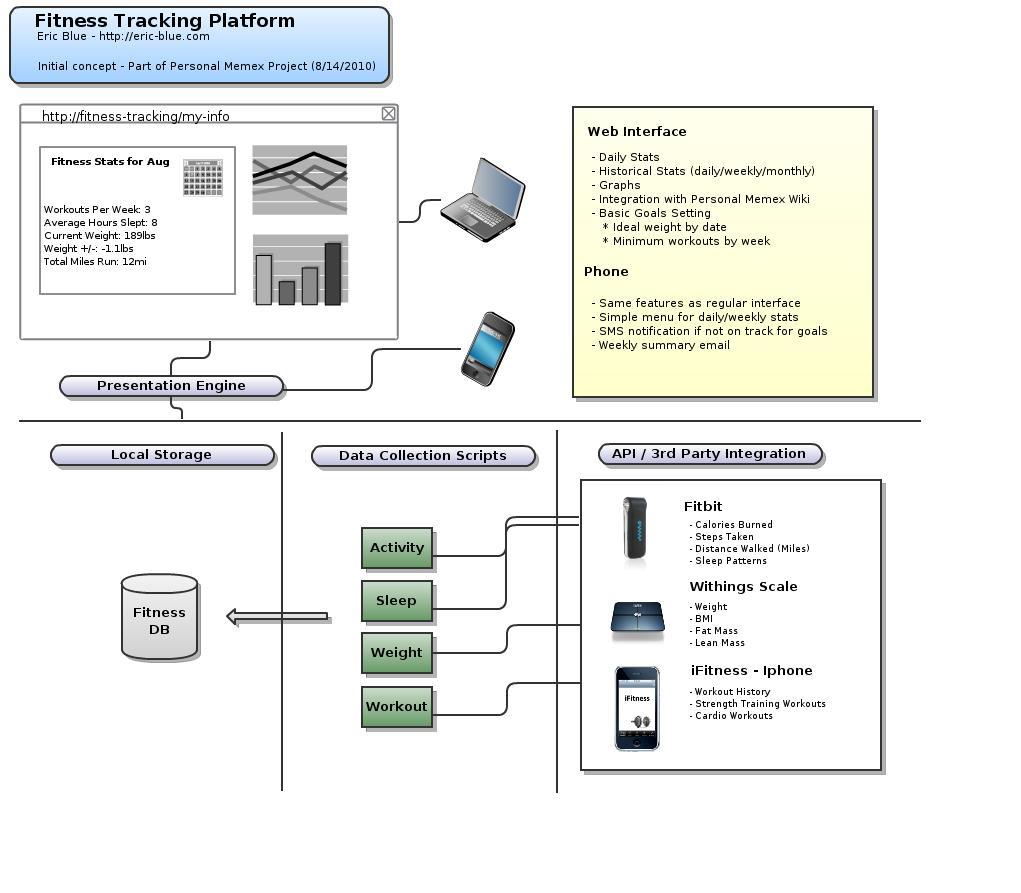
I’ve been thinking about ways to integrate all of this data from various products into a single
interface. My ultimate goal is to make this a sub-project of my Personal Memex project.
All areas of your fitness and health could theoretically be tracked from a single place. I
created a quick diagram to illustrate (Large diagram also
available on Gliffy):
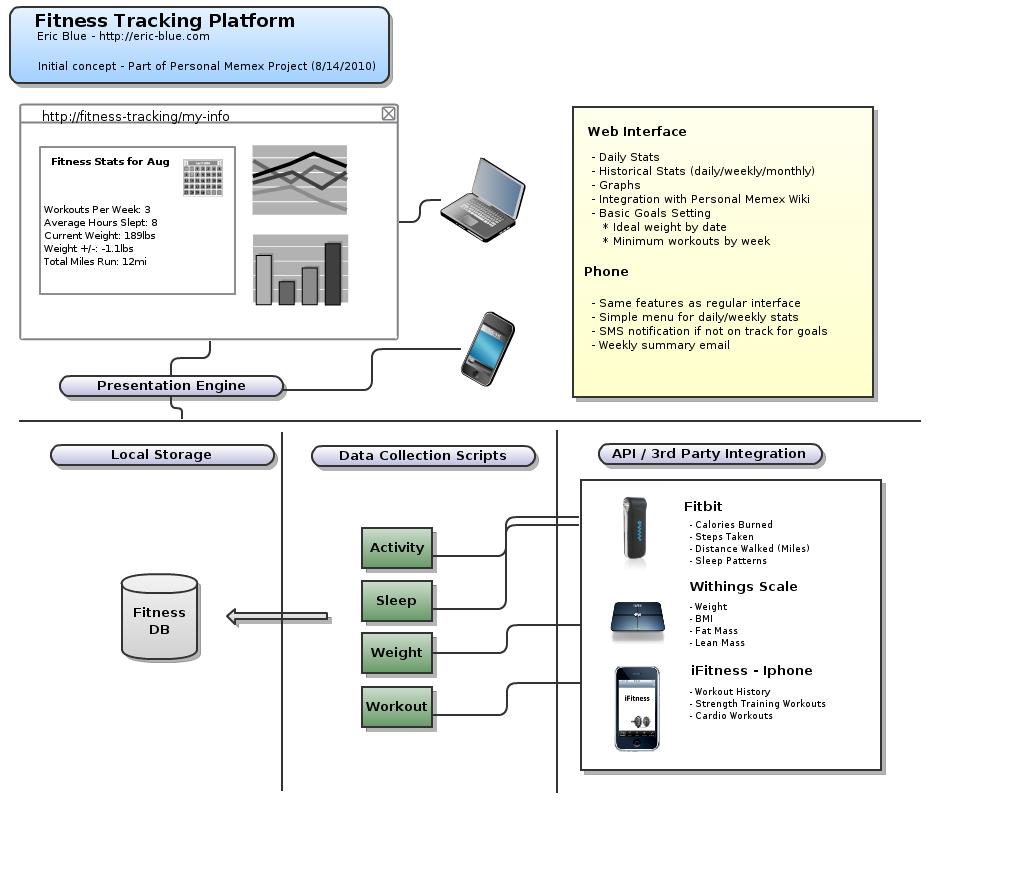 So, this looks fancy, but what are the practical applications?
1) Keeping your weight under control. Being able to see your trends, coupled with current
activity (coming from FitBit and workout sheets) will allow you to gauge how active you need to
be.
2) Staying motivated to workout. Again, being able to see trends on how many times a week
you’re going to the gym or going outside to be active (walking, hiking, running) and getting
real-time notifications is a way to help you stay on track.
3) Observing your sleeping patterns to see how it relates to your overall stress and
productivity.
This may seem like a high degree of information logging and complexity for most people. But, I
think the real benefit is this: Low-maintenance and High-reward = Great results. Most of these
devices are already tracking this information, and with minimal development, systems could be built
to collect, aggregate, and present this information in ways that can help you shift your behaviors
and actions. These are all preliminary ideas right now, but my hope is to start prototyping
this over the coming months, integrate into my existing personal memex system, and then release this
proof of concept as an online demo.
9 Responses
-
Eric Blue’s Blog » Weekly Lifestream for August 22nd […] Shared Eric Blue’s Blog » Fitness Tracking Platform – Personal Informatics for Fitness. […]
-
 Stephen Lark
This guy has similar ideas to you:
Writing apps for your TV is cool but nothing compared to Your body API. Where is the iBody appstore?-
ericblue76
Stephen, thanks pointing this out. You have a knack for finding good stuff like this!
-
-
Shawn Phillips
Interesting Eric… I like the references and see some benefits to the idea of tracking for reflection and learning but / and I also see myself, nearly 20 years, digging, studying, writing code… convinced there was a better mouse trap to build, a way to create the perfect, motivational/tracking/success training tools / technology.
I learned a lot about what works, human behavior and built the first truly effective and rather advanced “computerized” training software the predicted, planned, tracked, etc…
All I can say is the human is an interesting and challenging mechanism that never ceases to astound and amaze…
Love to talk shop some day on this… though.
To Your Strength,
Shawn Phillips -
Brendan
I’m trying to do this, but also collecting health data especially for diabetics (BG level, insulin injections, food eaten with time, etc). I think collecting the info from a large number of people would let us do some interesting research.
Right now I use MyNetDiary to track food, Fitbit for activity, and Dexcom plus iPhone apps for other one off events (water drinking, stress level, etc). It’s hard to get the data though. Dexcom and MND export, but Fitbit does not. I am looking at your code to get all the fitbit data (minute by minute is what I’m after). Have you made any progress since your post about Fitbit? -
ericblue76
Hi Brendan,
Thanks for your post. Yes, getting some of these apps and services to export data can be a challenge. I’ve made some progress on my fitness tracking app since this post. At this point I’m collecting and importing both Fitbit and Withings data into my own database on a nightly basis. I’ve also created an initial ‘analytics’ UI to view graphs on a daily, weekly, monthly, and quarterly basis. I can see key metrics (weight, sleep, activity level, steps taken, distance, etc.). I’m probably close enough to a workable demo and pay put something online.
I’ve also started recently experimenting with Zeo (http://www.myzeo.com) for tracking detailed sleep activity/health and will add once the code is more polished.
For the FitBit API, since my original post a lot of work has been done by some other developers and a mature version is now hosted on CPAN (http://search.cpan.org/~genehack/WebService-FitBit-0.1_5/). You can get minute data (intraday) but only at 5-minute intervals since this is the only granularity to fitbit graphs provide. -
Alan Viars
Hi Brendan:
Very cool. I will explore the fitbit API. I’ve been working on a new server for aggregating many types of health information into a single place. It meant for use in groups/population as well as by individuals. The social graph is a big part of the system. Its called RESTCAT (Restful Extensible Server Technology for Comprehensive Activity Tracking). Its dual licensed so you can use it for free for personal use. Would love to knwo what you think.
Cheers,
Alan -
Eric Blue’s Blog » Fitness Tracking Platform: Update on Progress […] August, I enthusiastically blogged about an idea I had for creating a Fitness Tracking Platform; personal informatics for fitness. Since that time I’ve been gradually making progress and […]
-
Brent
Hi Eric:
I’m looking for an exercise DB that I can attach an automated activity/movement technology to. Have you developed an activity /exercise DB?
Thx
Brent
Comments are closed.