Quantified Strength
By ericblue Categories: Featured Fitness Headline Health Quantified Self | 0 comments

Background
For the past 6 months I’ve been obsessed with the idea of strength. Actually, obsessed is
probably a strong word but let’s just say *very* focused on being
functionally strong and balanced. This is a far cry from where I was 3-4 years ago after chronic
lower back issues originating during lifting (squatting specifically). During this period of
cyclical relapse I had become pretty physically inactive to borderline sedentary. It wasn’t a fun
time to say the least. Most attempts to get more physically active resulted in a lower back
flair up, and anything other than walking/limping for a few days afterwards was the extent of my
“workouts”.
It was around this time that I had first caught wind of
Life logging and the
Quantified Self movement. I had the notion that if I
could get better at monitoring my activity level, I could gradually improve , stop the whole relapse
cycle and pull myself out of the rut. Thanks to Fitbit, I was
pretty diligent over a 2 year period on maintaining and then gradually increasing my daily activity
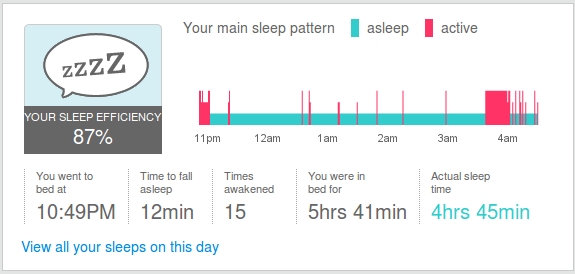
(e.g. walk x steps/miles per day). Speaking of Fitbit, here’s a now humorous chart of what
back pain spasms look like visualized in the early morning hours – I’ll never forget that night of
prolonged pain!
Luckily I did reach a period of 6 months without any major back relapse. This in large part
was due to a habit of morning 1-2 mile walks, and gradually getting back into weight training again.
I had a few stumbles along the way, and I’m not going to lie if was pretty frustrating when it
did happen, but I stuck with it. After about a year of keeping up a regimin of 2-3 days a week
weight training or running (5k treadmill work) and no back issues, I figured it was time to take
things to the next level.
Getting Stronger (and Scientific)
Along with numerous chiropractor visits, massages, stretching, workouts, etc. I knew that I needed
to fundamentally fix some of the muscular imbalances that had resulted from my chronic back issues,
and probably in fact were the root cause to begin with. I’d always been good at tracking my
workouts – sets, reps, personal records, etc. for most of my workouts. But, I never really
took a step back to look at the big picture. How did these workouts compare to others on
average, and more importantly, did I have any major weak areas that were causing imbalances that
would result in further back problems?
It seemed my bench press and upper body strength were fine, so this had me wondering about upper vs.
lower body and back strength. Because I originally injured my back doing squats I had totally
shied away from trying them again over the past 4 years. And, in my entire strength training
history I had never really tried deadlifts. So, starting in January I decided to take a leap
and push through a big mental barrier (read: fear of relapse) and actually try squats again.
To my surprise I did fairly well, and in the following weeks decided to start trying
deadlifts.
Around this time I discovered a number of publications and sites that published strength standards
on the big lifts – bench press, dead lift, and squat. My goal was to see how I compared to
these averages, and come up with a plan to ensure that the ratios between these exercises was as
healthy as possible.
For reference, here are some helpful links:
- Weight lifting performance standards – http://www.exrx.net/Testing/WeightLifting/StrengthStandards.html
- Ideal weight to strength ratio – http://www.livestrong.com/article/461397-ideal-weight-to-strength-ratio/
- Crossfit basic strength standards – http://www.crossfit.com/cf-journal/WLSTANDARDS.pdf
- How much can you lift – http://www.t-nation.com/readArticle.do?id=1823834
- Strength Standards App – http://www.strstd.com/
Roughly speaking, your deadlift should be the strongest exercises, followed by squats, then by bench
press. It turns out that for my baseline test, my numbers were completely upside down!
This can easily be explained by the long vacation away from squats, and the previously
non-existant deadlifts, but still this points to a problem. This is where having a plan, and
tracking to that plan are critical.
The Plan
The thing I love about these published strength standards is there are numbers to work towards, and
really levels and categories for how you compare to others, untrained, novice, advanced, elite.
I decided that one great way to look at this was as a game – how could I efficiently and
safely ‘level up’ to get my strength ratios healthy. It turns out my bench press fared very
well (no bragging), but the squats and deadlifts were.. well… pretty unimpressive.
Rather than grading strength on a 1RM (1 rep maximum – the most weight you can lift 1
time), I decided to grade based on what you can safely do with your working weight – 10 reps.
This is a bit safer than 1RM and doesn’t require a spotter. Here was the baseline from
Feb:
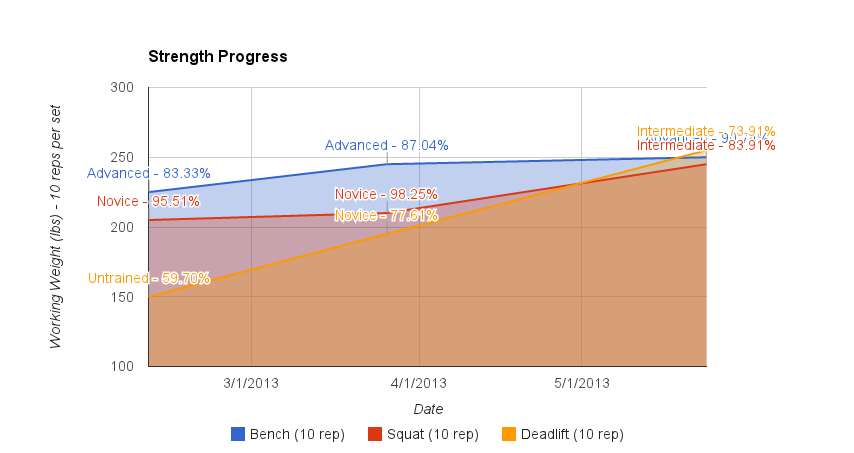
Bench press: 225lbs x 10 reps – Advanced
Squat: 205lbs x 10 reps – Novice
Deadlift: 150lbs x 10 reps – Untrained
As with most of my self-tracking projects, and in the spirit of all things Quantified Self, I
figured the best way to check my progress was to track my strength training. I was already
tracking my workouts – I didn’t want to be redundant, so the way I looked at this was to come up
with a higher level way to track progress. I decided that a good measure was to track the
following:
- My current level for each exercise (untrained, novice, advanced, elite)
- How close I was to approaching the next level as %
- Automatically convert my working weight 10 reps to a theoretical 1 rep max
- A ~8 week test showing a snapshot in time of my strength for each exercise
- A log of personal lifting records – 1 rep max attempts for bench, deadlift, and squat
I’ve shared a read-only copy of my Google Docs spreadsheet here. I’ve now done 3 recordings of strength tests, and for the first time deadlifts are now stronger than bench press. This is probably going to be another 6-12 month process to get a healthy ratio (5:4:3 – deadlift:squat:bench), but a major step in the right direction. For the first time in a long time I’ve moved on from a mindset of injury and pain, to one wear I absolutely want to excel and push boundaries.
Lessons Learned and Next Steps
This is only the beginning of this experiment and journey, but I’ve learned some things so far:
- Forget what you think you know. I spent years going to the gym, going through the motions, and just putting in time. Take a step back, revisit the basics if need be, and re-learn fundamentals on fitness, health, working out, etc.
- Find experts – this is critical. This fitness and health industry is inundated with thousands upon thousands of experts. I’m still exploring. It would take a number of future blog posts to talk about the great gems out there. But, here are a couple to start – there are a number of knowledgeable people on Facebook (check out Shawn Phillips of EAS and Full Strength fame) and Youtube (check out Elliott Hulse). These guys know their stuff.
- You have to work hard – I pushed my workouts from 2-3 days a week up to 4-5 days a week. In order to make significant progress you have to work at it. What started out as a goal to just get ‘normal’ again has turned into a goal to excel. This doesn’t happen over night but you have to be consistent.
- Get a workout buddy or somebody else you’re accountable to – I went a decade without a lifting buddy and in the last year have made more gains than in the past 10. If you can’t find a workout partner find a way to stay committed to going to the gym. Personally I like the app – GymPact – set a goal of x workouts per week or pay a self-imposed $$ penalty (also earn some bucks along the way).
- Appreciate your strengths and gradually work on your weaknesses. In terms of upper body strength I’m not focused on improving my bench too much. I’m diligently researching improving my squats and deadlifts (mobility, flexibility, proper form, different workout methods, etc.). I’m also in the process of finishing up a great book – Squat Every Day. This offers a paradigm shift on what it means to push yourself safely and really make some performance gains.
My plan is to continue with my weekly workouts and keep my strength tracking log up to date ~ every 8 weeks. I definitely plan to post my progress in the coming months and will share my discoveries along the way!